What a Medical Prescription Must Include in Mexico: A General Guide
If you're about to order your first custom prescription pad, it's normal to wonder exactly what information it needs to include. This is general information based on common practice at medical offices in Mexico and Mexico's official clinical-record standard NOM-004-SSA3-2012 (listed at the end): it doesn't replace whatever your professional board, state, or institution specifically requires, so it's always worth confirming with them before printing.
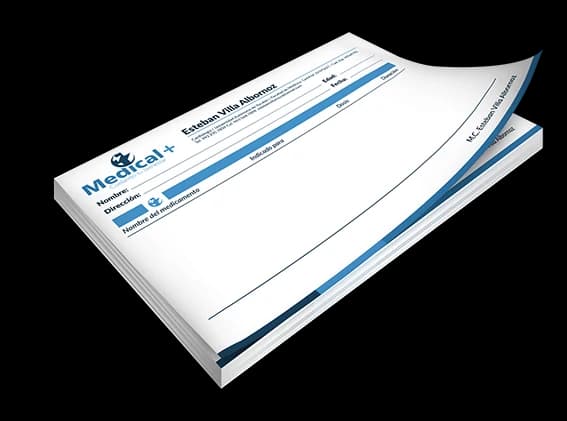
What goes on your letterhead
At the top of the prescription you'll typically find: your full name, specialty, professional license number (and specialty license, if applicable), and your practice's contact details: address, phone, and, if you want, office hours.
These are exactly the details that get preprinted on the letterhead when you order a custom pad: so you don't have to write them by hand on every single prescription, only what changes per patient.
What gets filled in per patient
In the body of the prescription, you add, per patient: their full name, the date of the visit, the diagnosis or reason for the visit (if that's part of how you work), the medication prescribed with dosage and treatment duration, and your signature.
Some practices also add the patient's age or weight when it's relevant to dosage, especially in pediatric practices.
Why it's worth preprinting the fixed details
Every time you write your license number or your practice's phone number by hand, there's a chance for a mistake or for it to come out illegible: which can cause problems if the patient takes the prescription to a pharmacy that checks those details.
Having the letterhead preprinted solves that once and for all: you approve the design a single time, and from then on, every prescription you fill by hand already carries your fixed details, correct and legible.